
INDEPENDENT APPS · 2026
Paths of Wonder
- My contribution
- Writing, product design & engineering
- Current chapter
- Reader built · stories and testing ongoing
- Explore
- Explore Paths of Wonder
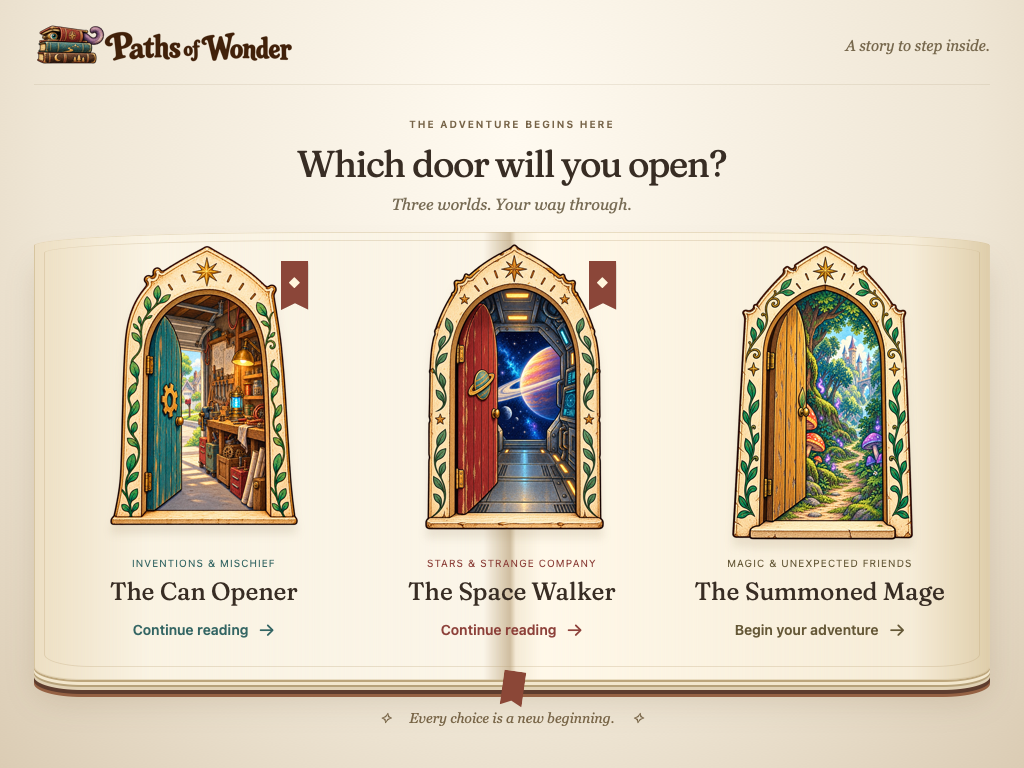
Choose a door.
Become part of the story.
Paths of Wonder began with a dad’s wish to write stories where children could take the lead.
Name the hero, name a piece of the world, and decide what to do when things get strange.
THE NEED
Let the reader steer the adventure.
I wanted to write branching stories where children could recognize themselves in the adventure. The reader needed to get out of the writing’s way.
I write the branching stories and built the reader around them. The engine separates story data, navigation, and reader state, so a branch can change without redesigning the app.
02 · THE MAKING
The craft behind the choices.
Choose
Three worlds to explore, from a neighborhood full of malfunctioning robots to a strange starship and a land running out of magic.
Name
Readers name their hero and part of the world. Those names become part of the authored story.
Decide
Choices lead to different scenes and endings, giving a second reading somewhere new to go.
Return
Each book keeps its own local progress and reading preferences. Stories, fonts, and artwork are bundled into the iOS app.
WHAT WORKS TODAY
The reader is built. The stories are growing.
- Three authored adventures are in development, with choices that lead to different scenes and endings.
- The reader is packaged for iPhone and iPad, with local progress and reading preferences for each book.
- Stories and testing remain in progress. The planned October 2026 launch depends on that work being ready.
BUILT WITH
React · Vite · Capacitor · Custom story engine
Last reviewed September 2026